
TriQDef: Disrupting Semantic and Gradient Alignment to Prevent Adversarial Patch Transferability in Quantized Neural Networks
Published in ICLR, 2026
Core Insight
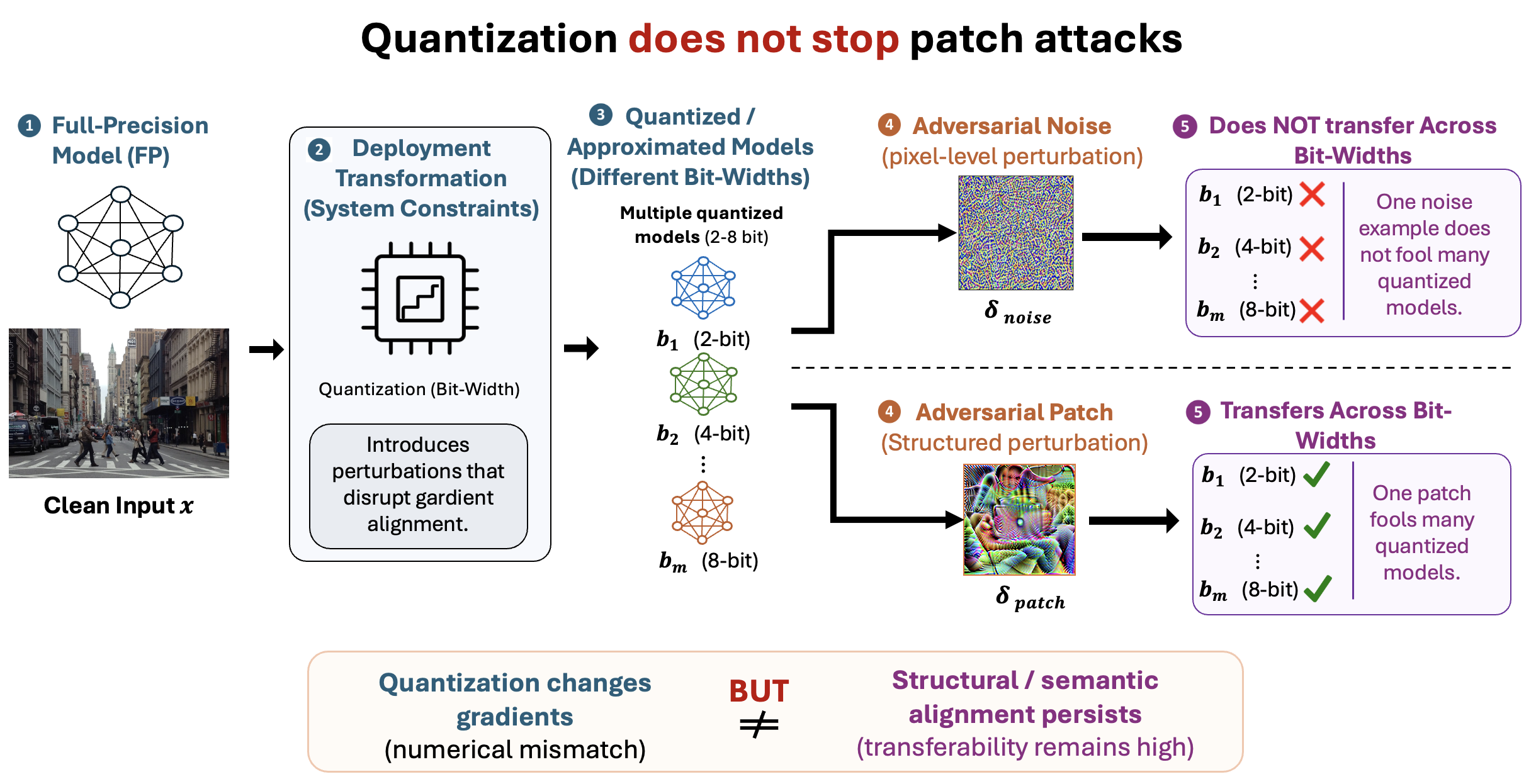
Quantization changes numerical precision, but does not break the underlying structure of learned representations.
Adversarial patches exploit this hidden consistency, remaining transferable across bit-widths.
TriQDef shows that robustness requires disrupting structural alignment in both features and gradients.
Links
- Paper: OpenReview
Motivation
Quantized Neural Networks (QNNs) are widely deployed in edge and embedded systems due to their efficiency.
It is often assumed that quantization improves robustness by distorting gradients.
However, we observe:
Patch-based adversarial attacks remain highly effective across bit-widths — even at 2-bit precision.
This reveals a critical gap:
- quantization disrupts local gradients
- but preserves global structure
Why Does Transferability Persist?
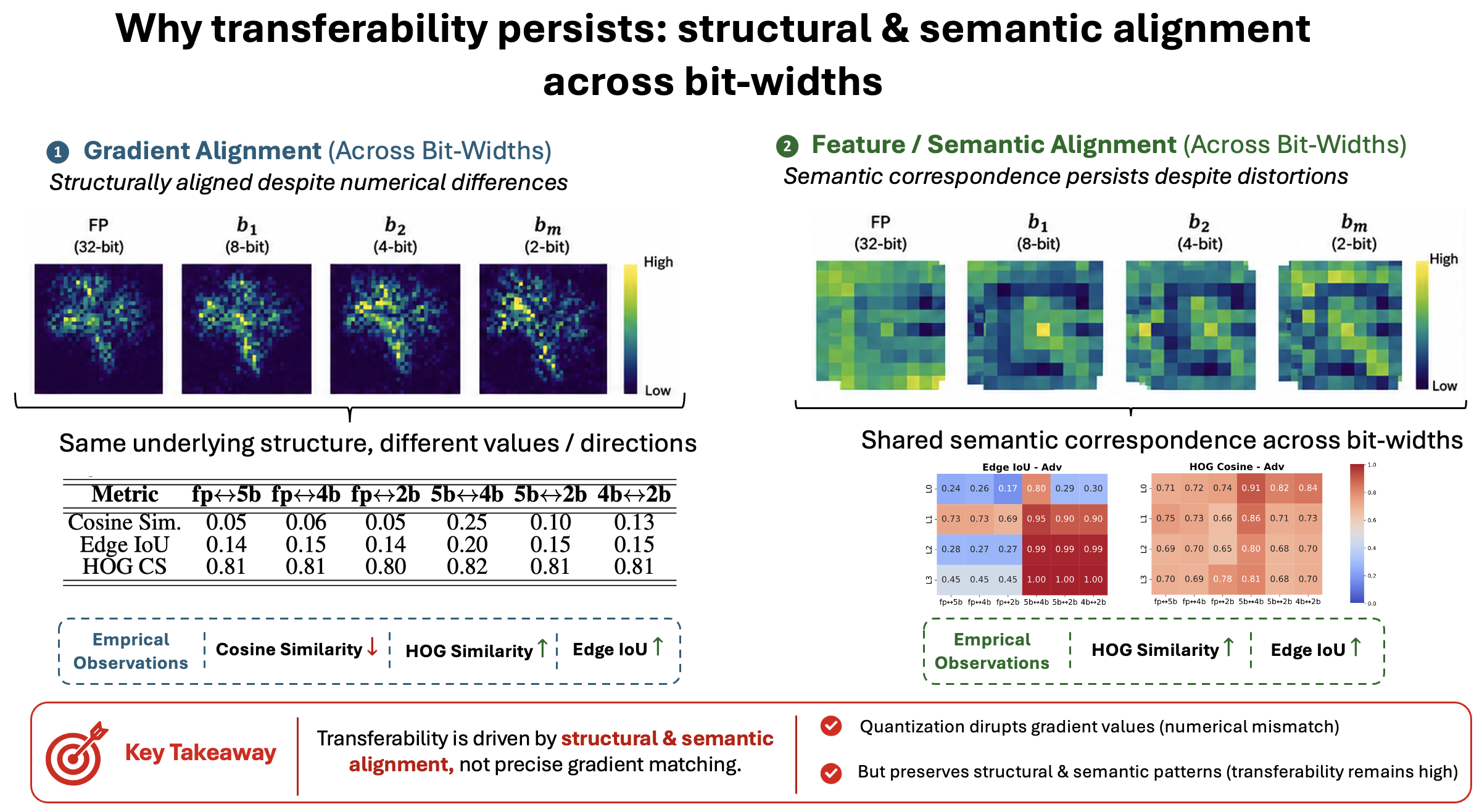
Despite low cosine similarity, gradients across bit-widths exhibit high structural alignment:
- similar edges
- similar orientation distributions
- similar spatial patterns
This explains why patch attacks transfer:
they rely on perceptual structure, not precise gradient values.
Method Overview
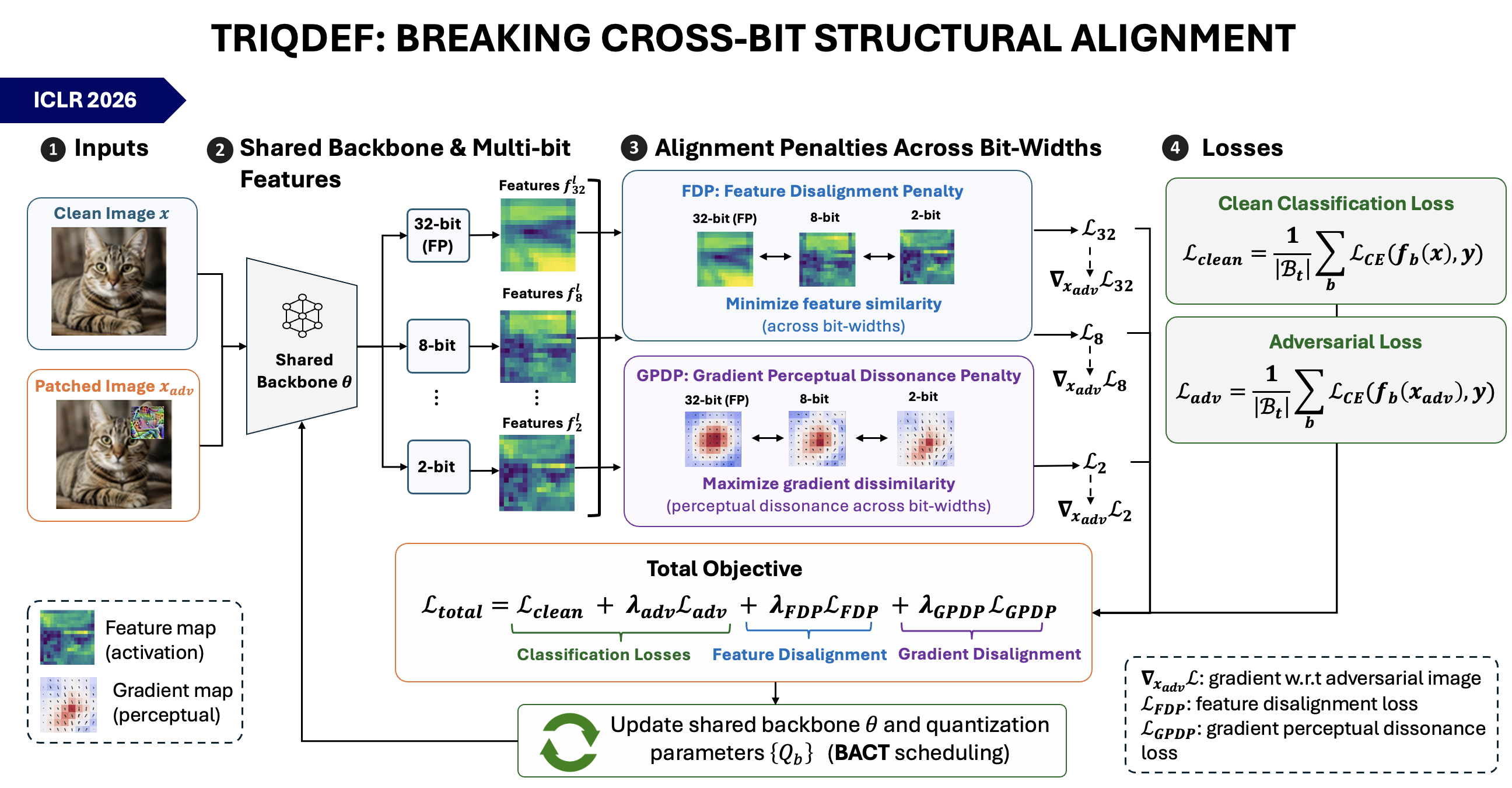
TriQDef is a tri-level defense framework designed to break alignment across quantization levels:
Feature Disalignment Penalty (FDP)
→ disrupts semantic consistency across bit-widthsGradient Perceptual Dissonance Penalty (GPDP)
→ misaligns gradient structure using Edge IoU and HOG similarityBit-Width-Aware Curriculum Training (BACT)
→ progressively enforces robustness across quantization levels through curriculum-based training
Together, these components break the shared structure that enables patch transferability.
Abstract
Quantized Neural Networks (QNNs) are widely deployed in resource-constrained environments due to their efficiency. While quantization distorts gradient landscapes and weakens pixel-level attacks, it provides limited robustness against patch-based adversarial attacks, which remain highly transferable across bit-widths.
We propose TriQDef, a quantization-aware defense framework that disrupts cross-bit transferability by targeting both feature and gradient alignment. The framework integrates a Feature Disalignment Penalty (FDP) to enforce semantic inconsistency, a Gradient Perceptual Dissonance Penalty (GPDP) to misalign gradient structure using perceptual metrics, and a Bit-Width-Aware Curriculum Training (BACT) strategy to progressively enforce robustness across quantization levels.
Experiments on CIFAR-10 and ImageNet show that TriQDef reduces attack success rates by over 40% on unseen patch and quantization configurations while maintaining high clean accuracy. These results demonstrate that structural alignment—not numerical precision—is the key enabler of patch transferability in QNNs.
Key Contributions
- First systematic study of patch transferability across quantized neural networks
- Reveals that structural alignment persists despite gradient distortion
- Proposes TriQDef, a defense targeting both feature and gradient alignment
- Introduces perceptual alignment metrics (Edge IoU, HOG Cosine) to quantify structural similarity
- Achieves >40% reduction in attack success rate on unseen patches and quantization settings
- Preserves high clean accuracy with minimal deployment overhead
Results
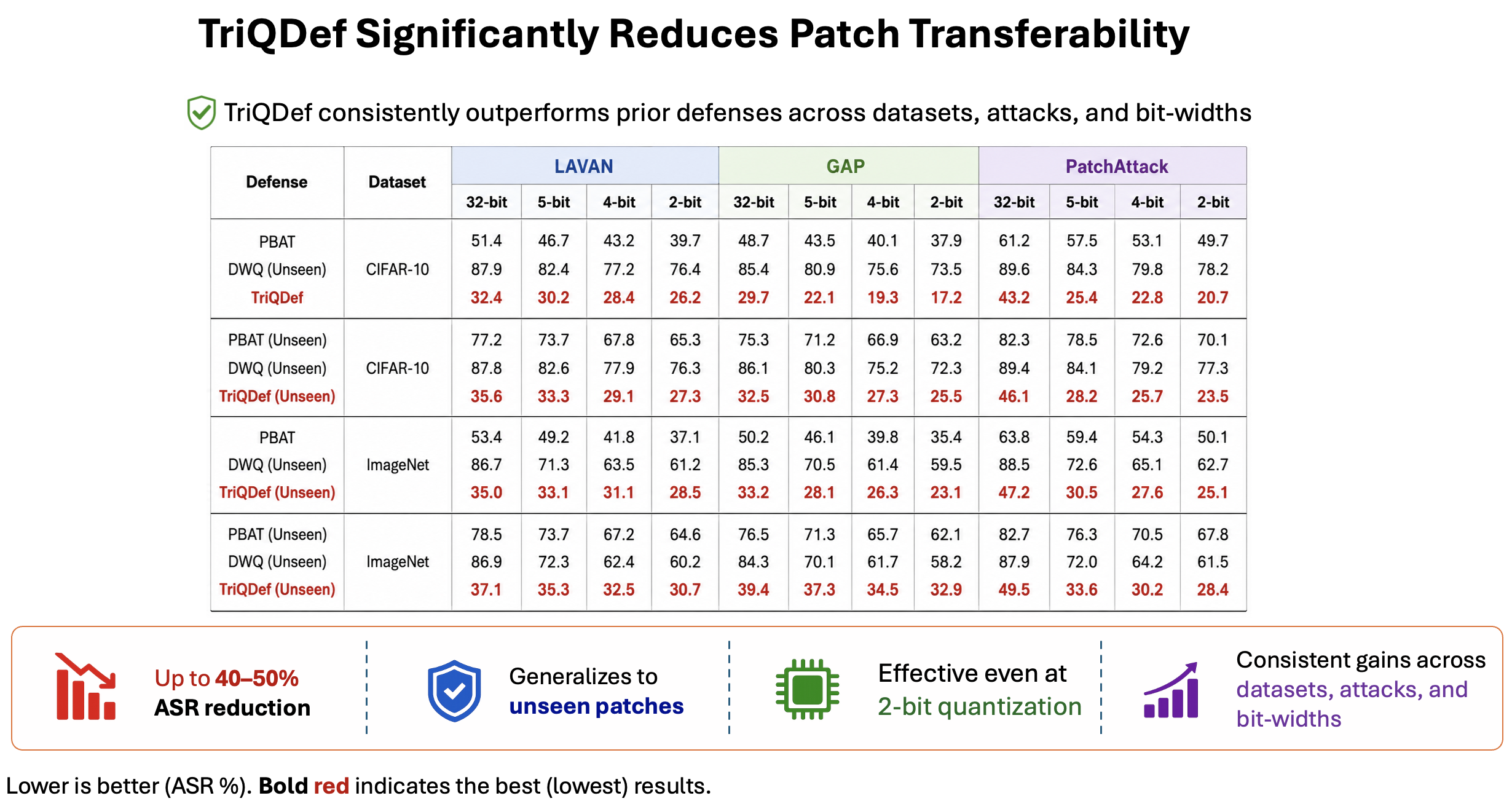
TriQDef significantly reduces patch transferability across bit-widths.
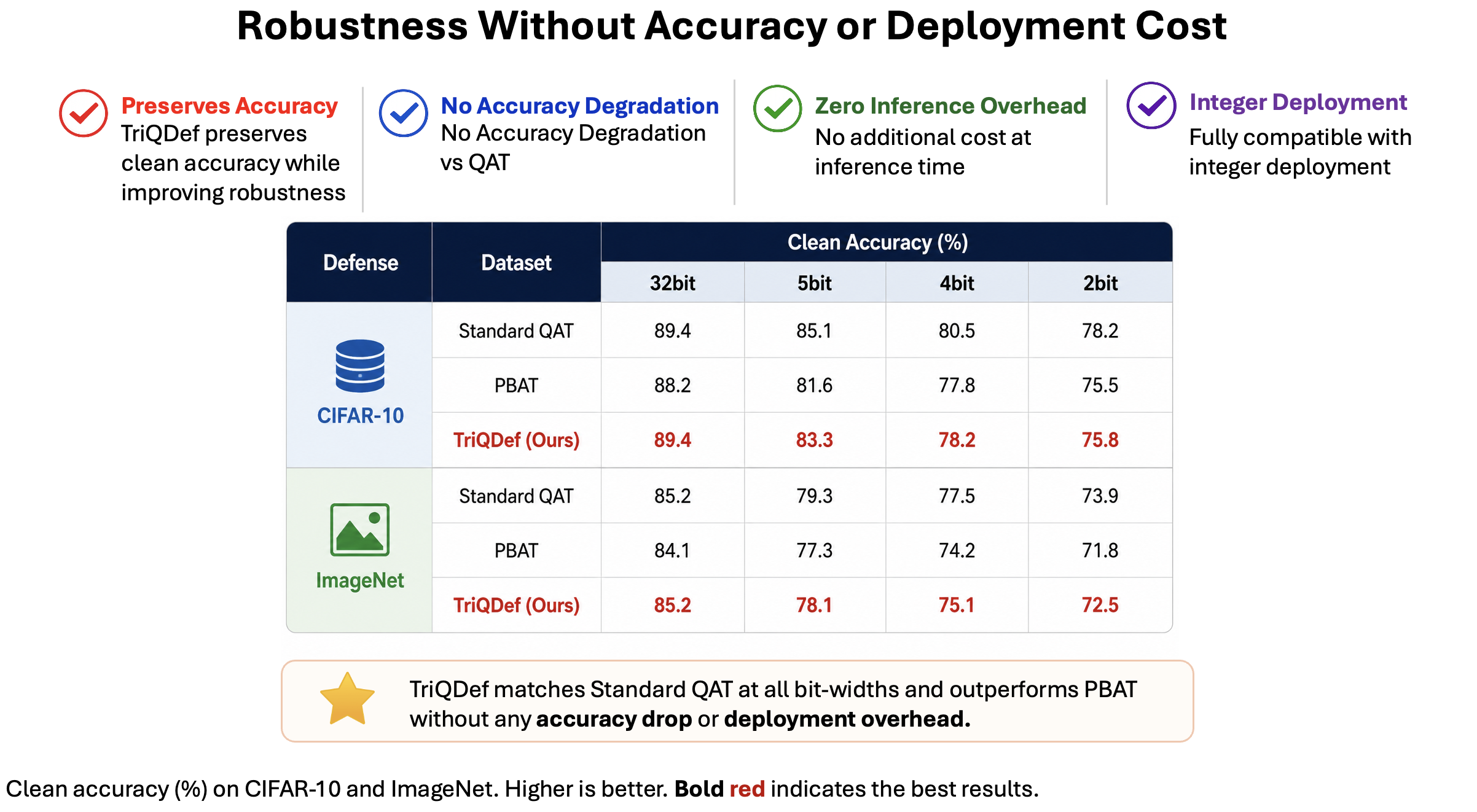
Maintains strong accuracy without increasing deployment cost.
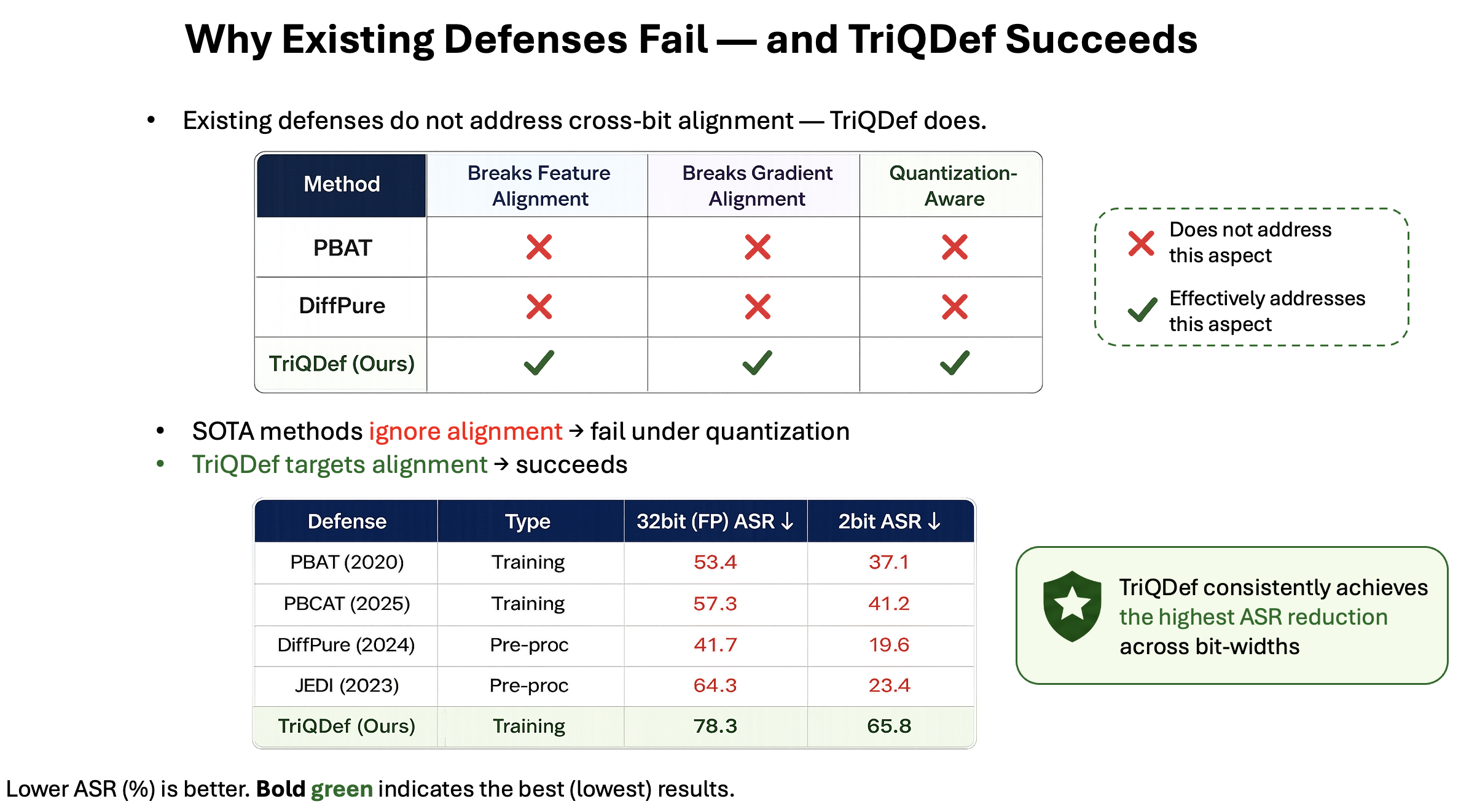
Outperforms existing defenses by explicitly targeting structural alignment.
Why This Matters
TriQDef challenges a common assumption:
Robustness cannot be achieved by perturbing numerical precision alone.
Instead, it shows:
- vulnerabilities arise from shared structure
- transferability is driven by alignment
- robustness requires controlled divergence
This has implications for:
- edge AI deployment
- quantized and approximate computing
- secure machine learning under hardware constraints
Broader Perspective
TriQDef is part of a broader research direction on:
Alignment as the root cause of adversarial transferability
Across models, architectures, and bit-widths:
- alignment → transferability → vulnerability
- disruption → divergence → robustness
This principle underlies my work on:
- quantized neural networks
- adversarial patches
- Vision Transformers and cross-architecture attacks
- multimodal consistency and hallucination
Citation
@inproceedings{guesmi2026triqdef,
  title={TriQDef: Disrupting Semantic and Gradient Alignment to Prevent Adversarial Patch Transferability in Quantized Neural Networks},
  author={Guesmi, Amira and Ouni, Bassem and Shafique, Muhammad},
  booktitle={International Conference on Learning Representations (ICLR)},
  year={2026}
}