Defensive Approximation: Securing CNNs using Approximate Computing
Published in ASPLOS, 2021
Links
- Paper: Link
Overview
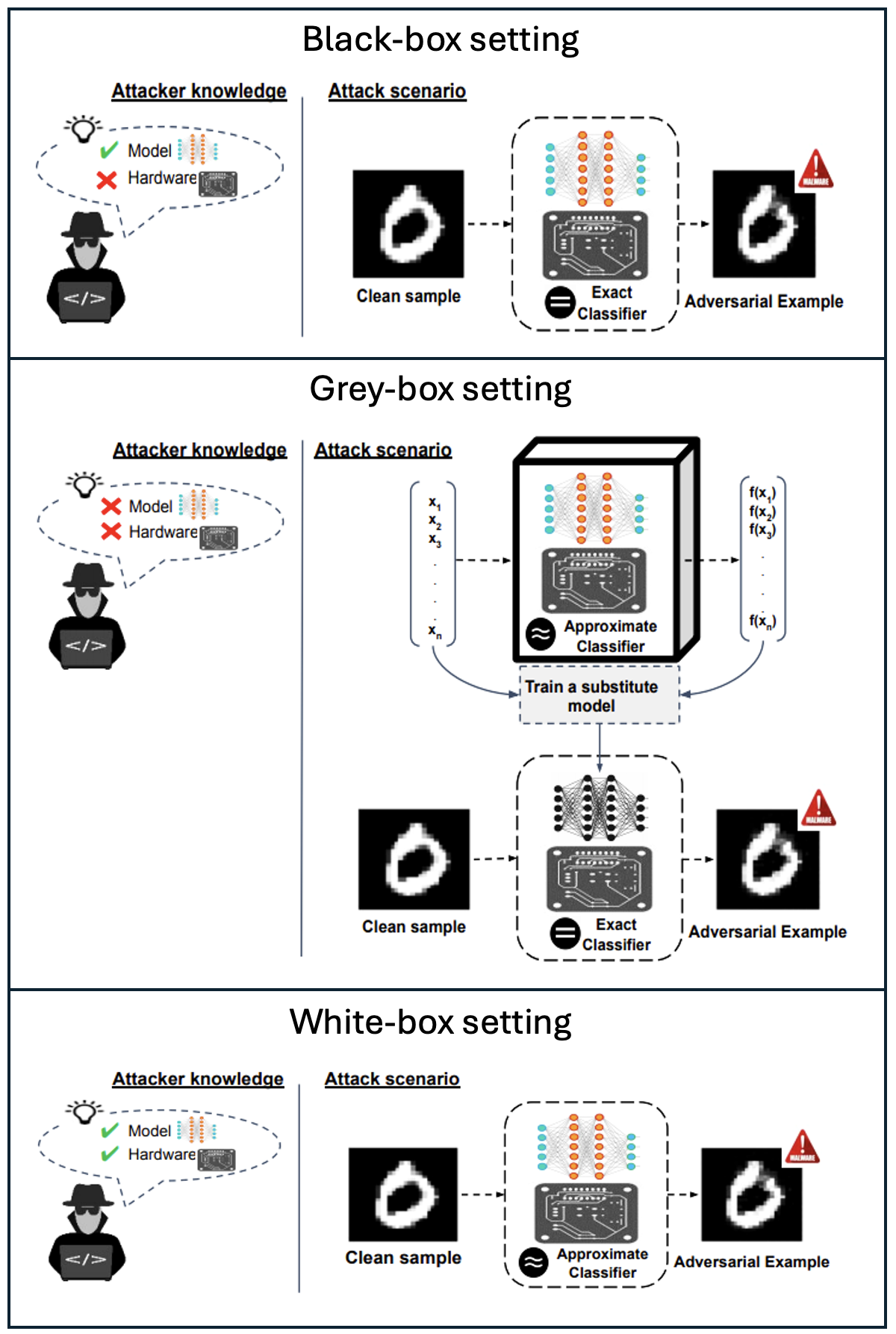
Defensive Approximation (DA) is the first work to demonstrate that hardware-supported approximate computing can be used as an effective defense against adversarial attacks on deep neural networks. Instead of modifying training or preprocessing inputs, DA injects data-dependent approximation noise directly inside CNN computations, fundamentally disrupting adversarial transferability while preserving accuracy and improving efficiency.
Abstract
Adversarial attacks pose a serious threat to machine learning systems deployed in safety- and security-critical domains.
This paper proposes Defensive Approximation, a novel defense mechanism that leverages approximate computing at the hardware level to improve robustness of convolutional neural networks (CNNs) against adversarial attacks. By replacing exact floating-point multipliers with aggressively approximate ones, the proposed approach introduces input-dependent perturbations throughout the model, significantly reducing attack transferability in gray-box, black-box, and even white-box settings.
Importantly, this robustness is achieved without retraining, while simultaneously reducing energy consumption and latency. Extensive experiments on MNIST and CIFAR-10 demonstrate robustness improvements of up to 99% against strong transferability-based attacks, with up to 50% energy savings.
Key Contributions
- First hardware-level adversarial defense using approximate computing
- Strong robustness against:
- Transferability attacks
- Black-box attacks
- White-box attacks
- No retraining or model modification required
- Significant energy and latency reduction
- Improves model confidence while preserving accuracy
Related Research Directions
This work laid the foundation for later research on:
- Robustness of quantized and approximate neural networks
- Hardware–software co-design for AI security
- Transferability disruption via non-deterministic computation
Citation
@inproceedings{guesmi2021defensive,
  title={Defensive approximation: securing cnns using approximate computing},
  author={Guesmi, Amira and Alouani, Ihsen and Khasawneh, Khaled N and Baklouti, Mouna and Frikha, Tarek and Abid, Mohamed and Abu-Ghazaleh, Nael},
  booktitle={Proceedings of the 26th ACM international conference on architectural support for programming languages and operating systems},
  pages={990--1003},
  year={2021}
}